Thursday, October 9, 2008
Nathan Bierma's Columns are Missing
The Chicago Tribune changed their format. Some like it, and some don't. It's thinner, though busy, and more like the Internet. In fact, on the top of the page, an arrow shows you where you are in relation to the other sections. I found that rather innovative. In general, though, it seems less intellectual and more glitzy. I've always loved the separate book section of the Tribune, and now it's just one page in the regular paper. Then one of my favorite columns, Nathan Bierma's "On Language" won't appear anymore. Doesn't that just figure? The comics and food section and fashion are all there. Why take away the intellectual sections. I suppose it's yet another comment on society.

Saturday, October 4, 2008
The Language of Sarah
There is so much ammunition that I don't know where to begin. Do we really want a VP (or God forbid a President?) who says, "How long have I been at this, like 5 weeks?" She speaks so informally, similar to a 16-year-old, not a 44-year-old. And what about "Joe six-pack" or "I am a hockey mom"? Is she really so stupid to think that being a "mom" qualifies her to be the head of one of the most powerful countries in the world? Puleezzz! She can't even pronounce Shiites, much less know anything about them. And why didn't the media pick that gaffe up? Further, twice she called Senator Biden "O'Biden" and nobody mentioned that. Is the media afraid of her? Are they afraid she'll say the media is against her? What a load of you know what!
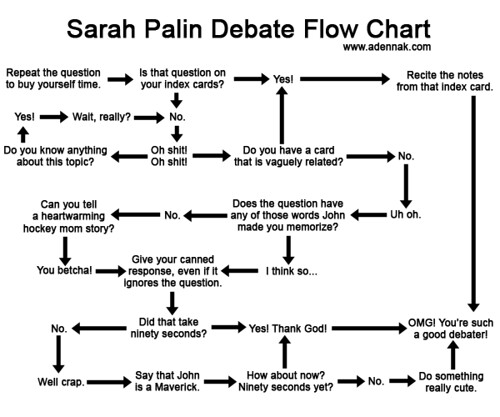
I found this link that Proofreader sent me quite funny, and this link within it, about diagramming sentences, is precious. Then there is this diagram of her debate.
Have we Americans really descended this far that this woman is actually a VP candidate. I don't think they'll win, but, still, they could.
I found this link that Proofreader sent me quite funny, and this link within it, about diagramming sentences, is precious. Then there is this diagram of her debate.
Have we Americans really descended this far that this woman is actually a VP candidate. I don't think they'll win, but, still, they could.
Friday, October 3, 2008
Being Right
This is not an epicaricacy post (I note that Mozilla cites epicaricacy as a misspelled word), nor a word post. However, I am wondering, why is it that smart people always want to be right? And worst yet, why is it when smart people are wrong, many don't admit it? They beat around the bush and rationalize or become quiet. However, to merely say, "I'm wrong" is too much. Strange.
Sometimes I feel that we can't have an intellectual conversation on Wordcraft because somebody has to point out somebody's gaffe or some very small, always insignificant, side subject. Perhaps it's the Internet. People don't have to face each other and say, after someone's questioned the meaning of a sentence, "I think it's clear enough." Or maybe intelligent people just have a stronger need for being correct. I tend to think it's the latter. As for me, I am tired of it, though I guess it's the nature of things on the Internet. However, it is irritating.
Speaking of irritating, those of us who live in Chicago are irritated with our Cubs. I wrote this for Wordcraft:
Higgledy Piggledy
Cubs of Chicagoans
Got us excited for
Winning it all.
Now in the play-offs they've
Un-blanking-lievably
Lost the first two and they
Surely will fall!
Here's another DD about one of my gaffe (which surely was pointed out to me!):
Higgledy Piggledy
Arnie, the Londoner,
Rightly concludes that the
Plaintiff is "he."
Kalleh, however, so
Characteristically,
Took it quite literally.
How can that be?!!!
Sometimes I feel that we can't have an intellectual conversation on Wordcraft because somebody has to point out somebody's gaffe or some very small, always insignificant, side subject. Perhaps it's the Internet. People don't have to face each other and say, after someone's questioned the meaning of a sentence, "I think it's clear enough." Or maybe intelligent people just have a stronger need for being correct. I tend to think it's the latter. As for me, I am tired of it, though I guess it's the nature of things on the Internet. However, it is irritating.
Speaking of irritating, those of us who live in Chicago are irritated with our Cubs. I wrote this for Wordcraft:
Higgledy Piggledy
Cubs of Chicagoans
Got us excited for
Winning it all.
Now in the play-offs they've
Un-blanking-lievably
Lost the first two and they
Surely will fall!
Here's another DD about one of my gaffe (which surely was pointed out to me!):
Higgledy Piggledy
Arnie, the Londoner,
Rightly concludes that the
Plaintiff is "he."
Kalleh, however, so
Characteristically,
Took it quite literally.
How can that be?!!!
Tuesday, September 30, 2008
Conglomeration...
Talk about peevologists: Oh dear!
In Googling around a bit, I found, first of all, that epicaricacy has nearly 9,160 Google hits now. Only 2 years ago it had only 572 Google hits. It also now is in Wiktionary, which hasn't always been the case.
In Googling around a bit, I found, first of all, that epicaricacy has nearly 9,160 Google hits now. Only 2 years ago it had only 572 Google hits. It also now is in Wiktionary, which hasn't always been the case.
Friday, September 26, 2008
A reader's observation
Interesting. A reader emailed me and pointed out that I used the same construction that I abhor...right in this conversation. Here is what I had said:
On the other hand, those who have one point of view (and you can always predict what it will be), those who will argue their views on and on for days on end, those who don't pay any attention to other sides...they are anti-intellectual and probably not worth listening to.
Is this the same? We have talked about it, and I said my verbiage sounds correct to me. He said maybe it's a matter of "proximity." Maybe. But most likely I have made the very same mistake that I have criticized.
Thursday, September 25, 2008
Language Log weighs in
The question about "my mother she is good" was asked on Language Log. Here is what Liberman said. Cat's comment here seemed right on. It is a very old construction, from Old English, and has been decreasing in use since the 1500s. Further, according to Language Log, it is now considered either informal or archaic. Interestingly, they used a comma in their examples, such as "my mother, she is good." I think that adds a little more legitimacy to the construction, but not that much. At any rate, the construction is called "left-dislocation." I don't know if it requires the comma or not, but I am not going to ask. Enough on this is enough!
If you'd like to see our discussion about this on Wordcraft, here it is.
Tuesday, September 23, 2008
"I am NOT wrong!"
Did I sound like a know-it-all in yesterday's entry? Probably.
One thing I've noticed as I've become more seasoned (I hate that word "older!") is that those who listen to the other side, who think about other perspectives, who analyze and synthesize with a variety of evidence...are the thinkers I most respect. On the other hand, those who have one point of view (and you can always predict what it will be), those who will argue their views on and on for days on end, those who don't pay any attention to other sides...they are anti-intellectual and probably not worth listening to. Yes, I've been in the latter category sometimes, probably when it comes to language and certainly when it comes to politics. But I don't like that about myself...or about others.
Therefore, I have taken a step back from my adamant post yesterday and have decided that linguistically and grammatically a comment like "My mother she is good" apparently is considered correct. I've heard that from the experts (and I really don't want to be considered a prescriptivist or peevologist). I'd never use that kind of phraseology, and I'd correct my kids if they were to use it. But fair is fair. It must be just a stylistic form that I despise. I am not a linguist or language specialist or English teacher. If they say I am wrong, so be it.
For the record, though, I don't see how the sentence, "my mother she is good" is an apposition. Isn't it a given that a "mother" is a she? In the example given in Wikipedia "my friend" and "Alice" are appositions because Alice describes my friend. But does "she" describe "mother?" I don't think so.
Subscribe to:
Posts (Atom)